
Elementary Space Plasma Physics 基礎太空電漿物理學
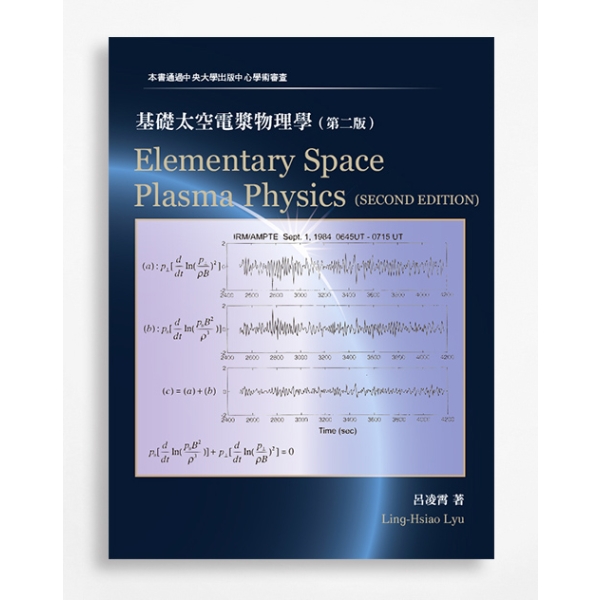
Elementary Space Plasma Physics 基礎太空電漿物理學
NT$450
作者:Ling-Hsiao Lyu(呂凌霄)/國立中央大學太空科學研究所、大氣科學系副教授
出版日期:2010/12
語文:繁體中文
ISBN/識別號:9789866286674
訂購連結:


随着太空电浆物理现象的不同,其所涵盖的特征尺度范围可小至电子的惯性尺度,也可大至磁流体力学(MHD)的尺度。虽然利用磁流体电浆模型,已经可用来描述许多的太空物理现象,但是就像大气物理中的地转风模式一样,我们应该要谨慎考虑它们的适用范围。本书的重点之一,就是要教导学生,科学家是如何得到那些特定电浆模型的控制方程式,并让读者了解,要获得这套控制方程式,需要做哪些基本的假设。我们相信,除非学生能彻底了解各种电浆模式的控制方程式以及它们的线性色散关系是如何推导出来的,否则是很难真正了解不同电浆模型的适用条件,也自然很难对症下药,选用正确的电浆模式,来解释分析观测到的物理现象。
本书一开始先介绍电浆微观动力模式、电子-正离子双流体模式、与单流体电浆模式的基本方程式。接着介绍电子-正离子双流体电浆与磁流体电浆中的线性波色散关系式。并于本书后段介绍电浆微观动力模式中的线性波色散关系式。因为认识带电粒子在相空间中的运动轨迹,将有助于了解电浆微观动力模式中,波与粒子的交互作用,因此在介绍电浆微观动力模式的线性波色散关系前,本书将先介绍如何分析带电粒子在不同电磁场环境中,所可能出现的多重时间尺度的运动情形。
本书是针对两学期研究所课程所设计的教科书。内容只涵盖电浆物理的基本课题,因此授课老师可在一学年的时间里,轻松的教完本书全部的课程。本书中第二、三章所推导的各种基本方程式,可为太空观测资料的分析工作以及不同尺度电浆模拟码的设计工作,提供非常实用的理论基础。包括了太空物理、天文物理、与实验室电浆物理等领域的学生与研究人员将发现本书的内容实用,且对相关研究工作有所帮助。
The characteristic scale lengths of various space plasma phenomena range from the electron inertial length to the magnetohydrodynamic (MHD) scale length. The MHD plasma model in the space physics is like the geostrophic-wind approximation in the atmospheric physics. Both of them have the limitation in their applications. One of the important goals of this book is to show the students how scientists obtain the governing equations of a given plasma model and what assumptions have been made to obtain the set of governing equations shown in the literatures. We believe that, unless the students know how to derive the governing equations and how to obtain the wave mode from a simplified linear dispersion relation, it will be difficult for the students to fully understand the limitations of a given plasma model and to apply the right model for the observed phenomena.
The basic equations of the kinetic plasma, the ion-electron two-fluid plasma, and the one-fluid plasma are derived at the beginning of this book. They are followed by the examinations of linear-wave dispersion relations in the ion-electron two-fluid plasma and in the one-fluid MHD plasma. The linear-wave dispersion relations in the kinetic plasma are presented at the end of this book. Because understanding the particle trajectories in the phase space are essential to the study of the wave-particle interactions in the kinetic plasma, the multiple-time-scale particle motions are examined before studying the linear-wave dispersion relations in the kinetic plasma.
This book is written for a two-semester graduate course. It contains only the fundamental subjects in the plasma physics. Thus, an instructor can easily cover the entire book in two semesters. The basic equations derive in Chapters 2 and 3 are particularly useful in analyzing the space plasma data and in designing simulation codes for different plasma models. This book is of interest to students and researches in space physics, astrophysics, and laboratory plasma physics.
吕凌霄
国立中央大学太空科学研究所&大气科学系副教授
美国阿拉斯加大学费班克分校太空物理博士
研究专长:太空物理、电浆物理、数值模拟
国立中央大学太空科学研究所&大气科学系副教授
美国阿拉斯加大学费班克分校太空物理博士
研究专长:太空物理、电浆物理、数值模拟
Ling-Hsiao Lyu
Associate professor, Institute of Space Science ﹠Department of Atmospheric Science National Central University.
Ph.D., University of Alaska Fairbanks, USA, 1991.
Physics, Plasma Physics, Numerical Simulation
Preface
Chapter 1 Introduction
1.1. Definition of Plasma
1.2. The SI Units and The Gaussian Units
1.3. Temperature in Units of oK and eV
1.4. Boltzmann Relation
1.5. Debye Shielding and Debye Length
1.6. Plasma Parameter
1.7. Plasma Frequency
1.8. Gyro Frequency and Gyro Radius (or Larmor Radius)
1.9. Collisions
Chapter 2 Deriving the Vlasov Equation From the Klimontovich Equation
2.1. Klimontovich Equation
2.2. Vlasov Equation
Chapter 3 Deriving the Fluid Equations From the Vlasov Equation
3.1. The Vlasov-Maxwell System
3.2. The Fluid Variables
3.3. The Fluid Equations
Chapter 4 Deriving the Vlasov Equation From the Liouville Equation
4.1. Liouville Equation
4.2. BBGKY Hierarchy
Chapter 5 Linear Waves in the Electron-Ion Two-Fluid Plasma
5.1. How to Linearize the Nonlinear Plasma Equations
5.2. Linear Plane Waves in Uniform Two-Fluid Plasma
5.3. Dispersion Relations of High-Frequency Waves in a Uniform Two-Fluid Plasma
5.4. Dispersion Relations of Cross-Ion-Electron-Time-Scale Linear Wave Modes in Uniform Two-Fluid Plasma
Chapter 6 Linear Waves in the MHD Plasma
6.1. Linearized Wave Equations in a Uniform Isotropic MHD Plasma
6.2. Linear Wave Modes in the MHD Plasma
Chapter 7 Particle Motions With Multiple Time Scales
7.1. Periodic Motions and Drift Motions of a Charged Particle
7.2. Fluid Drift 103
7.3. Drift Motion in Time-Dependent Fields 106
Chapter 8 Equilibrium Solutions of the Vlasov Equation
8.1. Characteristic Curves of a Partial Differential Equation
8.2. Equilibrium Solutions of Time-Independent Vlasov-Maxwell Equations
Chapter 9 Electrostatic Linear Waves in the Vlasov Plasma
9.1. Landau Contour
9.2. Linear Dispersion Relations of Electrostatic Waves
9.3. Landau Damping
9.4. Nyquist Method
Chapter 10 Two-Stream Instability
Chapter 11 Linear Waves in the Vlasov Plasma
11.1. Linear Waves in Field-Free Plasma (E00, B00)
11.2. Linear Waves in Magnetized Plasma With Uniform Background B0
Appendix A Static Electric Field and Magnetic Field
A.1. General Solutions
A.2. Solutions of Special Cases
Appendix B Ohm’s Law in One-Fluid Plasma
Appendix C Frozen-in Flux
C.1. Proof of Frozen-in Flux (Method 1)
C.2. Proof of Frozen-in Flux (Method 2)
C.3. Conservation of Circulation vs. Frozen-in Flux in MHD Plasma
C.4 Equipotential Surface in MHD Plasma
Appendix D Curvature Drift
Appendix E Gradient B Drift
Appendix F Deriving the Relativistic Vlasov Equation From the Relativistic Klimontovich Equation
F.1. Relativistic Klimontovich Equation
F.2. Relativistic Vlasov Equation
Appendix G Functions of Complex Variable
G.1. Analytic Function & Residue Theorem
G.2. Branch Point and Riemann Surface
Appendix H Special Functions for Studying Linear Waves in Kinetic Plasmas
H.1. Bessel Function
H.2. Error Function
H.3. Plasma Dispersion Function
Index
联络人:萧杰如小姐
Tel : (+866-2) 2926 6006 #6218
FAX (+866-2) 2926 6016
地址 : 234 新北市永和区成功路一段80号18楼
Email: aporder@airiti.com